
The 50 greatest courses built since 2000
When the century began, golf course design and development were in a very different place.
Hundreds of new courses were opening annually, including dozens of stand-alone, upscale daily-fee facilities (sometimes termed “country clubs for a day”), a segment of new construction that’s all but extinct today.
The industry was coming off a blockbuster decade in which the top private courses, resorts and real estate developments were distinguished by the size of their budgets and up-market aspirations exemplified by everything from marquee clubhouses to ornate landscaping to fleets of state-of-the-art golf carts.
The architectural field in 2000 was broad, with the likes of Jack Nicklaus, Tom Fazio, Tom Weiskopf, Rees Jones, Robert Trent Jones II, Arnold Palmer, Arthur Hills, Greg Norman, Pete Dye, Bobby Weed, Steve Smyers, Bob Cupp, Keith Foster, Mike Strantz, Jim Engh and others all competing for the most prestigious national jobs. Even regional architects in Y2K could count on a steady stream of new course work.
And in the background, a counterculture of hands-in-the-dirt, old world designers like Bill Coore and Ben Crenshaw, Tom Doak, Gil Hanse, David McLay Kidd and Mike DeVries were beginning to make noise.
The story of the 25 years since is one of inversion.
New course construction cratered during the recession of 2010, and even 15 years later it’s remarkable if 10 entirely new courses open in a year. Architectural focus has shifted to quality over quantity, with developers emphasizing great land over great budgets and pure golfing experiences over pure extravagance.
Real estate development courses, the backbone of the industry in the 1990s and early 2000s, also died, though there are signs of revival in Texas and Florida. Most of the vital work remains in remodels and renovations, the vast majority for private clubs, and the big-name firms of the aughts all downsized and remain smaller businesses, if they’re active at all.
And now the most sought-after names in architecture are those former outsider auteurs: Coore, Doak, Hanse, Kidd.
All of these trends are revealed as we look back over the last quarter century of the Golf Digest America’s 100 Greatest Courses rankings. We roared into the century in one architectural paradigm and find ourselves now in another. The residual power of traditional upscale clubs and resorts—specifically those from the aughts—continue to hold sway in our rankings, but no one then could have predicted how people would travel enthusiastically and at supreme cost to strange, desolate, sandy landscapes where it would have been laughable to build golf on 25 years ago.
To determine the 50 Greatest Courses of the 21st Century, we analyzed the 105 new courses that appeared on our America’s 100 Greatest and America’s Second 100 Greatest Courses ranking since 2001 (the rankings are published in odd years, and we expanded our list to 200 courses for the first time in 2013).
Next, we determined the average ranking of each of them over its tenure, so if a course appeared twice, once at No. 170 and once at No. 190, its ranking average would be 180. The lower the average ranking, the closer to the top of the list it appears.
It’s also important for relevancy to consider each course’s ranking trajectory. Some designs came into the 100 Greatest hot and then witnessed a tempering of excitement, and others have become appreciated only more recently. We’ve applied a Heat Index value to each design to reflect how courses are being scored in 2026 compared to how they were scored initially, tracking who is trending upward and who is not.
To make that calculation, we measured the overall movement from the course’s initial ranking to its current ranking. Points were added to courses that have fallen in the rankings (resulting in a higher total score, and thus a lower ranking), and points were subtracted for courses that have risen.
The more a course has risen, the more it benefits. Designs that have gained 5 to 10 places overall in the America’s 100/200 Greatest ranking since their inclusion received a reduction of 10 points from their average ranking (remember, the lower the score the better). We cut 15 points for courses that jumped 11 to 20 positions, and so on.
The results reflect how our course ranking panelists have viewed each course generally over the course of the last 25 years as well as where they see things now—a historical record of the 21st century alongside a more concentrated estimation of the architecture that’s most relevant today.
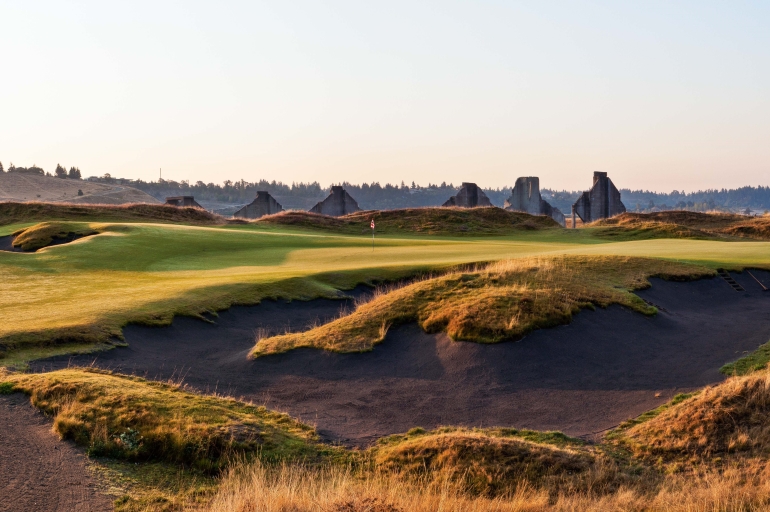
45. CHAMBERS BAY
University Place, Wash.
Robert Trent Jones, Jr. & Bruce Charlton (2007)
Rankings: 7, 2013 to current
Initial Ranking: 121
Current: 132
Average: 128.3
Heat Index: +10
Total Score: 138.3