
New York’s Biggest Golf Resort Just Got Bigger—And Better
A lot of golfers in New York complain about the crowded courses and lack of good public or resort golf in the Empire State. They obviously don’t know about Turning Stone. Not only is it by far the largest golf resort in New York State with five courses (three eighteens and two nines), it’s one of the biggest—and best—in the entire Northeast. It has also amassed an impressive 16 Forbes Stars—and will almost certainly soon have even more. It’s long been one of my favorite “hidden gems” and I’ve recommended it to friends for years, but New York’s biggest golf resort just completed a whopping $400 million expansion, one of the largest in recent hospitality industry history nationwide. The “Turning Stone Evolution,” added, among other things, an entirely new luxury hotel, the resort’s highest end restaurant to date and the largest resort convention center in the State.
That’s a lot, especially considering that Turning Stone is also the largest full-service casino in New York and already had a Forbes 4-Star spa, 4-Star lodging (The Lodge at Turning Stone), and two different 4-Star restaurants, TS Steakhouse and Wildflowers.
New York’s Biggest Golf Resort
The Golf
But first let’s talk golf, because that’s my main reason for visiting. Other people have other reasons, most commonly attending a convention at the huge facility, taking a spa vacation, or gambling. Turning Stone was the first land-based casino in New York, opened more than 30 years ago, and is owned by the Oneida Indian Nation. This is very important not just for gaming, but also for golf.
For three decades I have written extensively on casino golf courses, which are often among the best values in the sport, as they tend to be treated as gaming amenities, along the lines of free drinks, rather than profit centers. Casino golf courses are often better maintained and less expensive to play, with associated lodging for less than conventional golf resorts. All of this makes many casino golf destinations attractive to travelers, but compared to corporate casinos in places like Las Vegas, Biloxi, Atlantic City and Reno, Native American casinos tend to own huge expanses of land, as the casinos sit on their tribal territory, and there is almost never any residential real estate or other development on the course. This is the bane of many golf courses worldwide, even extremely expensive luxury resorts and private clubs in places like Florida and Arizona where you essentially play through a series of backyards and if you slice it ends up in someone’s swimming pool.
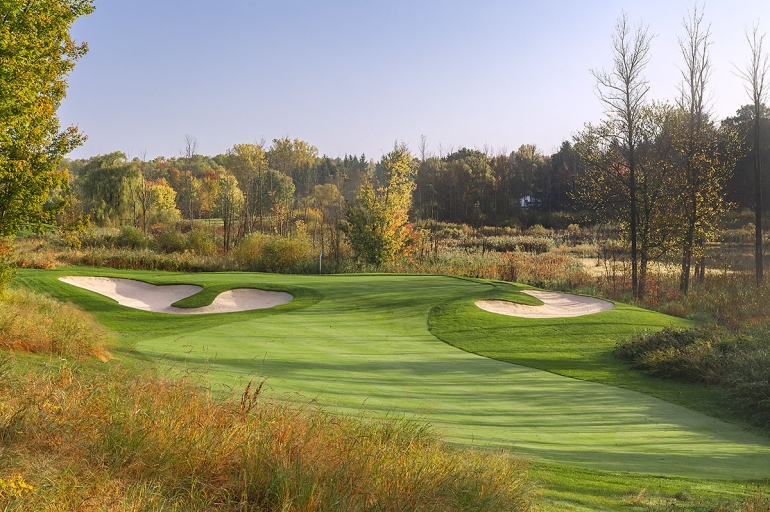
Just about anytime golf and residences co-exist, the golf loses, because when home plots are being sold, they get the most valuable land, which is why so many “oceanfront” courses, from Hawaii to the Carolinas, rarely touch the coast for more than a token hole or two—waterfront real estate is just too valuable for golf. At many Native American casinos, however, the golf courses get the best land and prime lake or riverfront, and are carved out of vast unspoiled nature, and Turning Stone is a perfect example. Other than the clubhouse and the casino hotel in the distance, you rarely see anything but the hole you are playing and a lot of trees. Golf is at its best in nature, and this absolutely golf in nature.
The flagship here is the Tom Fazio-designed Atunyote, which hosted a PGA Tour event for several years, as well as a charity mixed PGA and LPGA tournament. Among many of the sports greats, Tiger Woods has teed it up here repeatedly, along with Dustin Johnson and Matt Kuchar, the first American Olympic golf medalist in over a century. Atunyote is set a few miles from the main resort complex, with its own club house and practice facilities. All of Turning Stone is served by a free shuttle network 24/7, so whether you are going to a golf course or anyplace else, you never have to drive. The layout is wide open, and for amateurs the most benign of the eighteens, a bit of a surprise for a Tour championship layout, but it is still hard to score with fast, undulating and elevated greens that drop off in a nod to Pinehurst Number Two, and plenty of bunkers. It’s hard to lose a ball, but also hard to get it in the hole.
Back at the main casino resort campus, the other two eighteens run out of shared clubhouse right next to the casino. On these it is quite easy to lose a ball, and with a scary 150 slope and 75.5 rating from the tips, many golfers consider Kaluhyat to be the second toughest public course in the state after infamous Bethpage Black. The Robert Trent Jones, Jr. design plays through a series of wetlands, with narrow corridors and forced carries, along with some dramatic elevation changes and half a dozen lakes. If you are a single digit player, this one is for you, but everyone should play a tee shorter than their instincts suggest. Next door is Shenendoah, which has a similar landscape but everything is toned down a notch, so it is more playable. It has hosted the PGA National Club Professional Championship and was designed by Rick Smith.
All three layouts have been rated in the Top 50 Casino courses by Golfweek, both Kaluhyat and Atunyote have made the prestigious Golf Digest Top 100 You Can Play in the U.S., and Atunyote is currently ranked in the 10 Best Public Courses in the U.S. by USA Today.
That’s a lot under one roof, but there is also the ultra-fun Sandstone Hollow, a par-3 course designed by Rick Smith of Michigan’s “Threetops” fame, an architect renowned for his one-shotters. Again, it’s carved from wilderness and escapist, but unlike the current short-course craze, this is no pitch and putt, it’s real golf, with holes up to 240-yards. Atunyote, with its short game demands, PGA Tour legacy and high national ranking is the priciest tee time here, and if you are going to tackle it, a quick nine on Sandstone Hollow is a much better way to prep than the driving range, and you can play it in an hour. Pleasant Knolls, Turning Stone’s other nine, is a full-sized par-36 course with the regular assortment of par-3,4 and 5 holes. Yet again, the natural setting is first and foremost, and few 9-hole courses get 70-acres of pristine real estate.
Turning Stone also has a golf academy with private hourly lessons, multiple-lesson packages, club fitting, Aimpoint putting clinics, and 1-3 day immersion golf schools. Because it gets cold in upstate New York in winter, the resort built Sportsplex, a giant indoor facility under a weatherized dome that includes a 36-bay Trackman-equipped driving range, something you would be hard pressed to find anyplace else. It also has 17,000 square feet of short game practice area, including bunkers, plus winter tennis, pickleball and racquet ball.
The New “Evolution” Of New York’s Biggest Golf Resort
The biggest addition is the conference center, but frankly that only matters if you are going to a convention here. For most leisure travelers, the two big improvements are the Crescent and Salt. The former is an all-new 258-room luxury glass hotel tower in a crescent wing shape attached seamlessly to one side of the existing casino/hotel complex, and one of the key design features of Turning Stone is that almost everything that’s open in winter is interconnected so you rarely have to go outside. The rooms and suites in the Crescent feature a lot of space, floor to ceiling windows and oversized bathrooms, and the hotel has its own easy check-in, concierge and valet.
Salt Land & Sea is a modern steakhouse with heavy emphasis on ultra-freshly flown in seafood, especially an elaborate raw bar program. Turning Stone brought in acclaimed Las Vegas consultant and award-winning restaurateur Elizabeth Blau, most famous for Honey Salt, to create the concept. I got to eat there and loved it, the service was first-rate, especially for a place so new, the seafood on ice entry display was a stunner, and while steak is first and foremost, it has a very diverse and creative menu for a “Steakhouse.” After all, Turning Stone already has a classic American chophouse in TS, so Salt adds touches such as fresh pastas, seafood specialties like miso black cod and grilled whole branzino Mediterranean style, and a big focus on regional ingredients from the many farms of upstate New York. This is very much an agricultural region, and when you drive to Turning Stone you pass lots of cornfields, apple and peach orchards and the like, and all of these are reflected on the menu. So is steak, from a 12-ounce strip loin “steak frites” to a 40-ounce Tomahawk, and everything in between, including domestic wagyu, along with artisanal pork chops and chicken.
The Old Turning Stone
Before the Crescent opened, the top choice was the Forbes 4-Star Lodge, and it’s still a great option, set in a woodsy Frank Lloyd Wright inspired Prairie-style lodge rather than a gleaming contemporary tower. But rooms have the same floor to ceiling windows and opulent oversized bathrooms with walk in rain showers and soaking tubs. There’s no downside to either top lodging choice.
Turning Stone is huge and there are several other lodging options for every budget, along with numerous discounted golf and lodging packages. The Tower is a modern high-rise just a tier below the Lodge and Crescent. The Brook is a big 268-room hotel directly connected to the casino, popular with gamblers. Sandstone Hollow is the pet friendly option, with a low rise Courtyard by Marriott feel, next to the Sandstone Hollow golf course down the road from the main campus (with 24/7 shuttles). Finally, there’s the Inn, a motel style value proposition, and the Villages at Turning Stone, an RV park.
Not counting the multi-vendor food court there are16 distinct drinking and dining options here, from sushi to southern slow smoked BBQ. But the highlights besides the new Salt are the TS steakhouse, with an adjacent cigar lounge, a big rarity in New York, and the other Forbes 4-Star, Wildlflowers, with a varied Continental menu and focus on fresh products and local producers. Both are current winners of Wine Spectator’s Award of Excellence. I also liked Pino Bianco, a classic Italian American eatery complete with kitschy red and white checkered tablecloths. It features many fresh pasta dishes, including an odd regional specialty of Central New York that is almost completely unknown elsewhere but beloved locally, “Chicken Riggies,” rigatoni with chicken and hot cherry peppers.
For casino fans, this is a big one, with the full gamut of table games and slots, plus a large sports book and big poker room. Turning Stone hosts the World Series of Poker circuit events for the region, with 18 rings awarded throughout October.
The other very notable standout amenity that few large golf resorts can rival is Salmon Acres, the Oneida Nation’s private fly fishing reserve, with exclusive access on the Salmon River, one of the top angling spots in the Northeast. These waters have trophy sized fish including salmon (coho and chinook), trout (brown, steelhead), smallmouth bass, and northern pike. There is 36-acres of isolated frontage, offering both “Do It Yourself” and fully guided options.
Why Play New York’s Biggest Golf Resort?
The day I played Atunyote I got paired with a father and son from Washington, DC, and asked how they picked this resort. The dad told me it was a last minute trip, and he searched the internet for a resort with multiple high quality courses that was easy to get to and a cooler respite from the very hot DC summer. He found a very short list of suitable options, and Turning Stone was available and affordable. It is also just 30 minutes from the laid back Syracuse airport (which is also undergoing a major expansion, in part thanks to the new convention center here). They were able to grab a short nonstop flight and get here in time to tee it up, and they also said they loved the TS steakhouse. I, on the other hand, drove from my home in Vermont in three hours (I recently wrote here at Forbes about the best ski resort golf courses in New England, which are a great option at this time of year as we move into peak fall foliage season, but none of them have more than two courses and most have just one).
It’s not the first time I have made the drive over the years, because it is by far the largest golf resort I can get to in that time, not just for New York, but for all of New England. I’m not alone: several million people live within a 3-hour drive of Turning Stone and it is also less than 5-hours from New York City and another 20-plus million in the greater metro area. In short, there are a lot of people who have a lot of reasons to tee it up at New York’s biggest golf resort, and now they have even more options for great food and lodging.